BUMN with LinkAja Confronting Unicorn (Go-Pay & OVO)
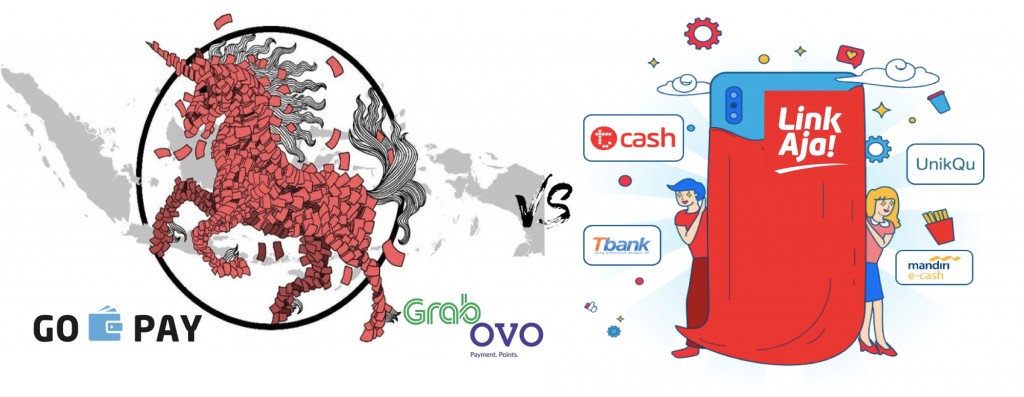
LinkAja Combines all server-based electronic money owned by BUMN
The dominance of two payment plates, namely Go-Pay and Ovo in Indonesia, disturbs the government. Based on the latest research from the Financial Times and the Social Daily with the Financial Services Authority (OJK), Go-Pay is the leader of payment systems in Indonesia, followed by OVO In the third place entrenched in T-cash from Telkomsel. Even though based on Bank Indonesia data, Go-Pay and OVO just been operating in Indonesia for five years. The Ministry of BUMN since the end of 2018 has encouraged BUMN to unite to form a payment platform called LinkAja. This product will officially launch next February 22. LinkAja will merge server-based electronic money from state-owned banks and the main platform using T-cash. LinkAja will be under Telkomsel’s Indonesian payment system fintech sector, PT Fintek Karya Nusantara (Finarya). Based on the openness of PT Telkom (TLKM) to the IDX, Telkomsel is Finarya’s largest shareholder with 25 percent, BRI 20 percent, BNI 20 percent, Bank Mandiri 20 percent, BTN 7 percent, Pertamina 7 percent, and Jiwasraya 1 percent.If not united, it is hard to fight the Ovo used by Decacorn Grab start-ups and Go-Pay by Unicorn Go-Jek. They don’t hesitate to “burn money” for business expansion. LinkAja has the opportunity to block Go-Pay and Ovo, because they will escape the banking system. If it is still under banking, it still has to follow strict bank rules. Plus fulfill compliance with the Financial Services Authority (OJK) and Bank Indonesia. When standing alone, LinkAja moves more agile.
Today, Go-Pay is the most popular digital payment brand in Indonesia, according to research results from the Social Daily titled ‘Fintech Report 2018’. In that research, fintech’s most popular e-money category included Go-Pay reaching 79.39 percent of 825 respondents. Followed, OVO as much as 58.42 percent. Then, T-cash (owned by Telkomsel) 55.52 percent, DANA 34.18 percent, and Paytren 19.27 percent. In this research, respondents could have more than two digital payment brands.
Not only that, with the joining of all state-owned enterprises, they can utilize their respective merchants, for example T-cash is strong in modern outlets in malls and traditional markets. While Bank Mandiri has long been an Indomaret partner. Bank BNI has collaborated with Alfamart. And reportedly, Pertamina is ready to support LinkAja. Server-based payment systems using QR code applications will indeed be increasingly popular.

The entry of BUMNs into the digital payment business is not without any reason. The digital payment industry in Indonesia is currently promising. The flow of electronic money transactions every year always soars. Based on data from Bank Indonesia, the nominal value of electronic money transactions in 2016 amounted to Rp7.06 trillion. In 2018, this value has exceeded Rp.47.19 trillion, up almost 7 times the 2016 realization. With this merger, it is expected that SOEs can compete more with OVO and Go-Pay and maximally work on Telkomsel customers. Currently there are 30 million T-Cash customers, while Telkomsel customers reach 150 million. BUMN banks also have an average number of customers above 10 million people.
Increasing Digital Service Revenue of Telkom with LinkAja
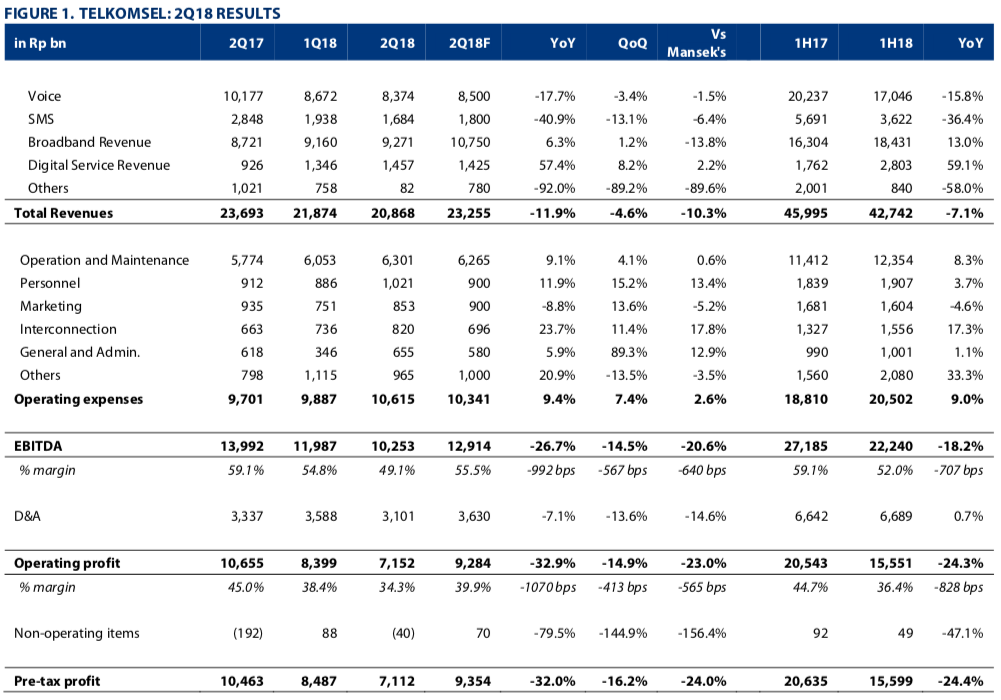
If we look to Telkomsel as subsidiaries of PT Telkom , 2Q18 Telkomsel revenues of Rp20.9tn (-11.9% YoY, -4.6% QoQ) missed our estimate by 10.3%. Voice and SMS revenue decline intensified to 17.7% YoY and 40.9% YoY, respectively, in 2Q18. Mobile data revenue growth also stalled to 6.3% YoY in 2Q18, from 20.8% YoY in 1Q18 and 28.2% YoY in FY17, despite the seasonal Ramadhan support. These revenue weaknesses are attributable to the aggressive competition during prepaid SIM card registration program, which ended in May-18, and the continued revenue shift from legacy to new wave/data. As of 2Q18, legacy revenue base (Voice & SMS) still forms 48% of Telkomsel’s total revenues and is declining at ~20% YoY. Hence, new wave revenues (data & digital services) must grow at least 30% YoY in 2H18 to return Telkomsel’s consolidated revenue growth to positive by FY18-end. Telkomsel has increased mobile data prices by 5-10% in June/July ’18 and could potentially do more in 2H18, but would need competitors to follow suit to ensure optimum pricing translation to revenues.
2Q18 Telkomsel Net Income of Rp5.31tn (-32.0% YoY, -17.3% QoQ) missed our estimate by 24.8%. Telkomsel booked lower non-operating expenses and stable effective tax rate on YoY basis. Telkomsel delivered relatively steady cost management in 2Q18, implying that the cost growth acceleration at Telkom Group was more driven by the non-Telkomsel segment. Given that, we still see avenues for earnings growth rebound at Telkomsel in 2H18, subject to Telkomsel’s success in leading industry price hikes.
In fulfilling many people’s changing behaviour in terms of telecommunications needs for digital services, Telkom will keep pushing forward with the Company’s transformation initiative to make Telkom a digital telecommunications company. Therefore the Company must continue to strengthen the development of digital infrastructure in both fixed line and mobile segments in an effort to provide the best digital experience including the development of new innovative products or services, while strengthening the business ecosystem to reach a sustainable growth in all digital segments of the market. Moreover, to further enhance digital capability, it is necessary to undertake acquisition and alliance initiatives that must be done selectively by considering risk and return aspects coupled with synergy of our resources and collective actions at Telkom Group.
In terms of financial and operational performance, Telkom expect to raise the bar higher even better than the industry’s growth has projected, in order to maintain or even increase market share. To that end, they have approved an adequate allocation of capital expenditures to support both organic and inorganic expansion efforts to achieve this strategic goal. With PT Telkom Indonesia Tbk (TLKM) through Telkomsel formed a new subsidiary engaged in the payment system financial technology (fintech) can increase digital service revenue and shifting to digital service not only in telecommunication but in everyday transaction.
The presence of LinkAja certainly cannot be underestimated by existing market players, such as Go-Pay, OVO and others. Moreover, LinkAja is supported by large BUMN companies, which have strong capital. In addition, several state-owned companies that have digital payments first also have a strong working partner base. If combined, the LinkAja partners will be more numerous, and of course this can be an attraction for customers to enter. LinkAja has ecosystem capital from bank customers, telecommunications customers, insurance, retail at gas stations that have been gripped by BUMNs. However, old players like Go-Pay and OVO have ecosystem support from online transportation that has been developed for a long time, but if LinkAja can embrace online transportation, then the competition will be even more exciting.
Lets just see where it goes 😀
Source :
- Annual Report PT Telkom, Tbk 2017 & Financial Report (Unaudited) 9M 2018 PT Telkom, Tbk
- Company Data, Mandiri Sekuritas Research estimates
- https://tirto.id/linkaja-uang-digital-ala-bumn-pesaing-go-pay-hingga-ovo-dg3H
- https://finance.detik.com/moneter/d-4425817/jadi-saingan-gopay-dan-ovo-siapa-yang-bakal-kelola-linkaja
About Post Author

Yuhuuu. Welcome LinkAja, hope this product take good xperience. And can make new advantage ecosystem for all system behind to make customer loyalty 😁 and this article related with my article about financial 4.0 😊😊
yass.. this is the biggest step for shifting to the front for incumbent in telecommunication and all bank’s in Indonesia to confront the unicorn.. And we are in the same page about financial in the future.. thanks tam.. 😀
Why “aja”? why not using “pay” or something (Just kidding 😁), thanks for nice sharing Mrs. Shandy, i really support local product to stand shine in heavy global competition right now. Well, in your opinion, would BUMN will also release its online transportation app since the probability is very small to be able to pay food and trip you order in unicorn app with LinkAja as the frequent reasons to top up its balance
In my opinion, this is more towards shifting minded .. which used to be paying with other apps, now there is new thing, so we want customers to move “aja”. But .
i will ask to our Leader for this .. hehehehe
and for transportation apps it can be happen, it doesn’t have to be as it is now (motorcycle and car), it can be for public transportation such as trains, buses, “angkot” just like in Singapore and Hong Kong, they are integrated. We hope so.. 😀 thanks for the question anyway